
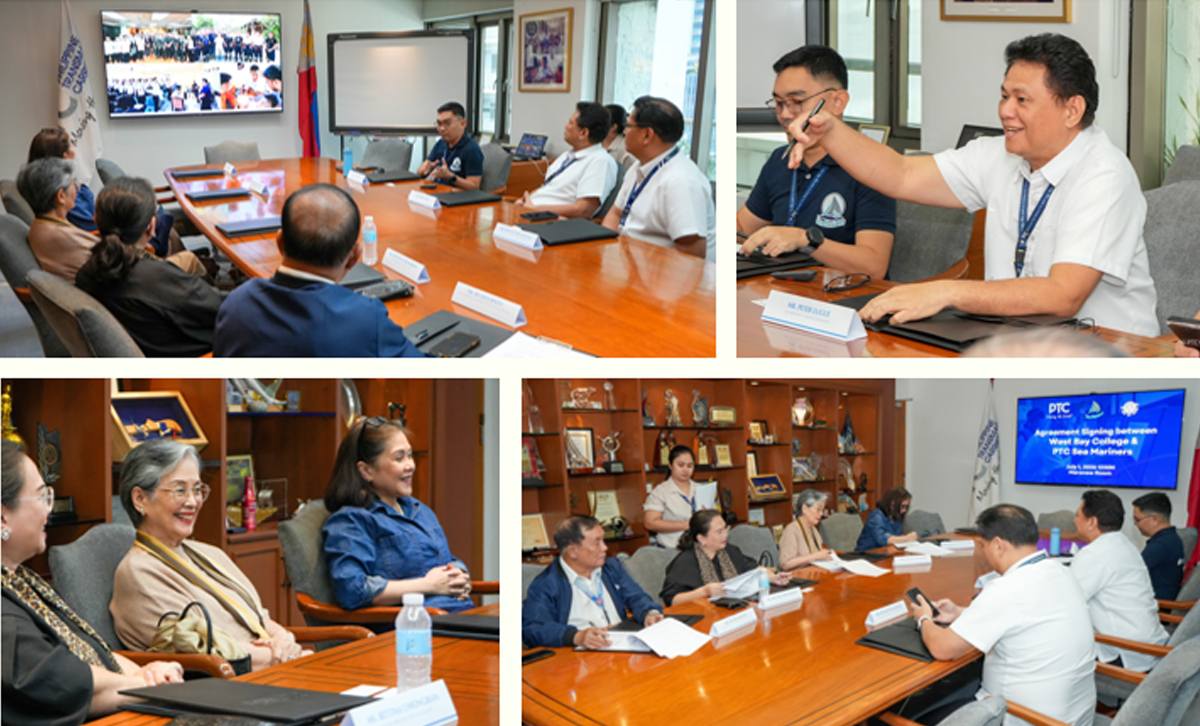
PTC Sea Mariners Program officially signed a Memorandum of Agreement (MOA) with West Bay College, formalizing a strategic industry-academe linkage.
The primary objective of the agreement is to bridge the gap between maritime educational institutions and the actual demands of the shipping industry. By uniting West Bay College’s academic framework with the Sea Mariners Program’s extensive industry network, the partnership ensures that cadets receive an industry-aligned curriculum, immersive technical training, and clear career pathways to global deployment.
Driving Leadership and Innovation
The ceremony was heavily supported by West Bay College’s leadership team. Institutional signatories and attendees included Mrs. Pauline Chiongbian (President), Mrs. Regina Chiongbian Poblete (VP for Finance), Ms. Bettina Chiongbian (VP for Operations), CM Emmanuel De Vera (OBT Supervisor), and Dr. Edgardo Geguiento (VP for Marketing & External Affairs / College Dean).
During the signing, West Bay College President Mrs. Pauline Chiongbian emphasized how vital this alignment is for the future of their students and the maritime sector as a whole:
“This agreement is a crucial step forward in ensuring our curriculum evolves alongside the rapidly shifting demands of the global shipping industry. By partnering with the PTCI Sea Mariners Program, we are not just giving our cadets a classroom education—we are providing them with the hands-on readiness, modern technological competencies, and direct career pathways they need to excel as globally competitive maritime professionals.”
Steering Towards Global Competitiveness
The collaboration focuses on transforming the educational experience through curriculum enhancement, hands-on training, and structured onboard training (OBT) monitoring. The alignment guarantees that maritime cadets are well-prepared to navigate the fast-paced, highly digitized modern maritime domain.
With this newly formalized partnership, the PTCI Sea Mariners Program and West Bay College set a solid trajectory for shared institutional growth, prioritizing high-quality education and practical readiness for the next generation of global maritime leaders.

Comments are closed