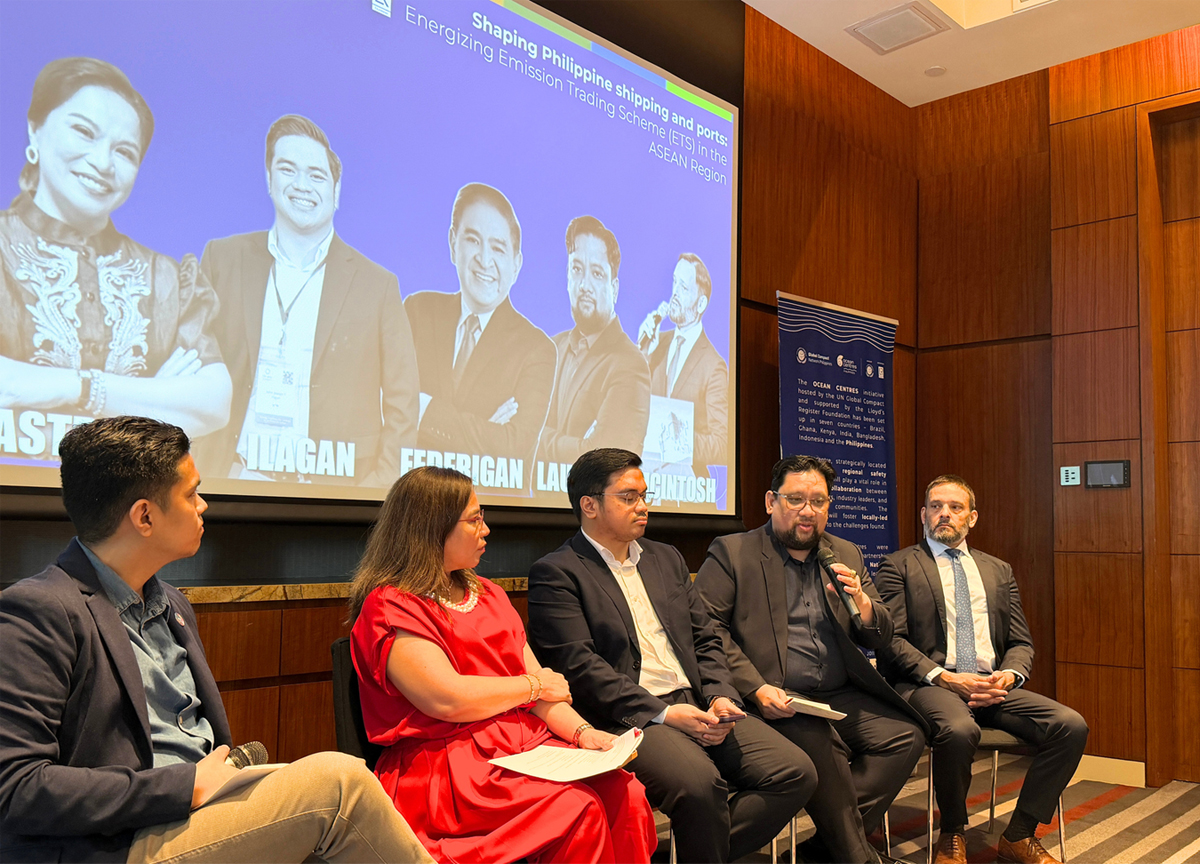
On 26 March 2026, the PTC Group took part in HALAGA: The Value of Blue Finance in the Philippines’ Safe and Sustainable Ocean Economy at the Grand Hyatt, BGC, joining a multi-sector dialogue on the future of maritime sustainability in the country. This workshop was hosted by The Ocean Centres PH – the oceans arm of the UN Global Compact. Representing the PTC Group was Chief MAKOi, PHILCAMSAT’s Training Manager for Digital Transformation and Innovation, whose industry experience and academic work on alternative marine fuels brought added depth to the discussion.
The event convened leaders from finance, government, industry, and coastal communities to examine how blue finance, carbon markets, and emission trading schemes can help build a safer, more resilient, and more sustainable ocean economy.
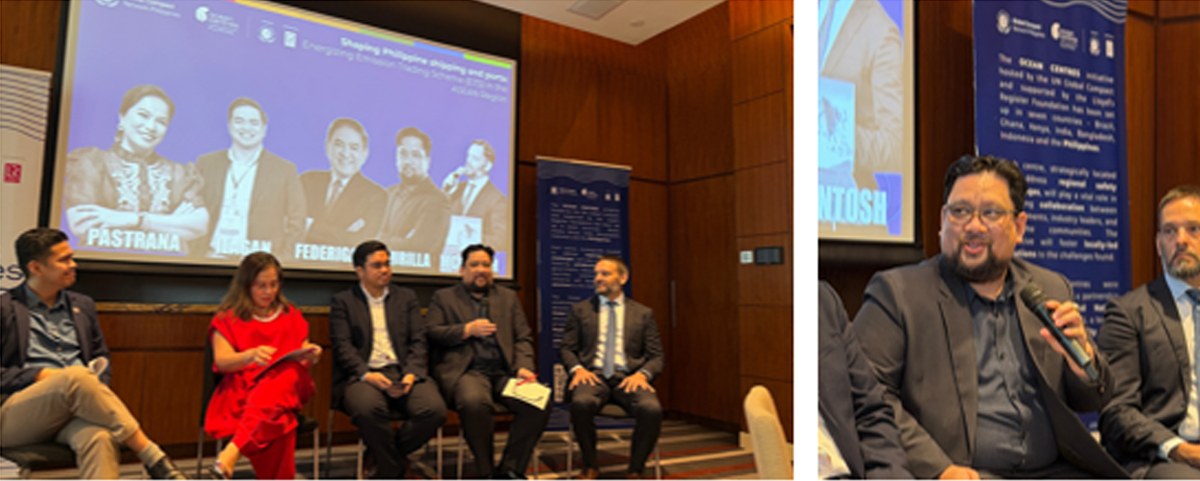
Chief MAKOi joined the panel “Shaping Philippine Shipping and Ports: Energizing Emission Trading Scheme (ETS) in the ASEAN Region),” where the discussion focused on how Philippine shipping and ports can respond to the growing regional push for emissions accountability, and how domestic operators can prepare for the practical demands of a possible ASEAN-wide ETS.
During the panel, Chief MAKOi underscored the role that organizations such as PTC can play in bridging the gap between global compliance expectations and local operational realities. He noted that while international best practices offer valuable guidance, they cannot simply be transplanted into domestic shipping without adaptation. Drawing from the experience of the sulfur cap transition in the Philippine domestic shipping – which was enforced globally back in 2020 but only implemented locally last year (a 5-year delay) – he pointed out that regulatory change is rarely just a matter of fuel or policy. It also depends on operational readiness, crew competence, and the technical realities onboard.
This, he explained, is where PHILCAMSAT plays a critical role. Through its Career Development Center, 2C or Cornerstone and Capstone program, and competence badging system, PHILCAMSAT helps translate evolving standards into practical capability at the shipboard level. The broader message was clear: decarbonization does not fail in policy; it fails in daily operations.
The panel also explored the importance of a just transition as the maritime sector moves toward stricter environmental standards. In this context, He highlighted the role of PTC in helping bring together industry, labor, and government around the human dimension of maritime transition. As new fuels, digital reporting requirements, and emissions-related regulations reshape the industry, the challenge is not limited to financing technology and infrastructure. It also requires meaningful investment in reskilling, training support, and transition pathways for the maritime workforce.
PTC’s involvement in advancing the Maritime Just Transition Task Force in the Philippines reflects that broader commitment. The discussion emphasized that a credible transition must not only reduce emissions, but also protect the people and communities whose livelihoods depend on the maritime sector. For domestic shipping in particular, where operations are closely tied to coastal economies, any transition must be phased, inclusive, and grounded in strong public-private collaboration.
Through its participation in HALAGA, the PTC Group, through PHILCAMSAT, helped reinforce an important point in the national conversation: that sustainability targets must be matched by practical systems, workforce development, and collaborative strategies that make transition both operationally realistic and socially responsible.

Comments are closed