
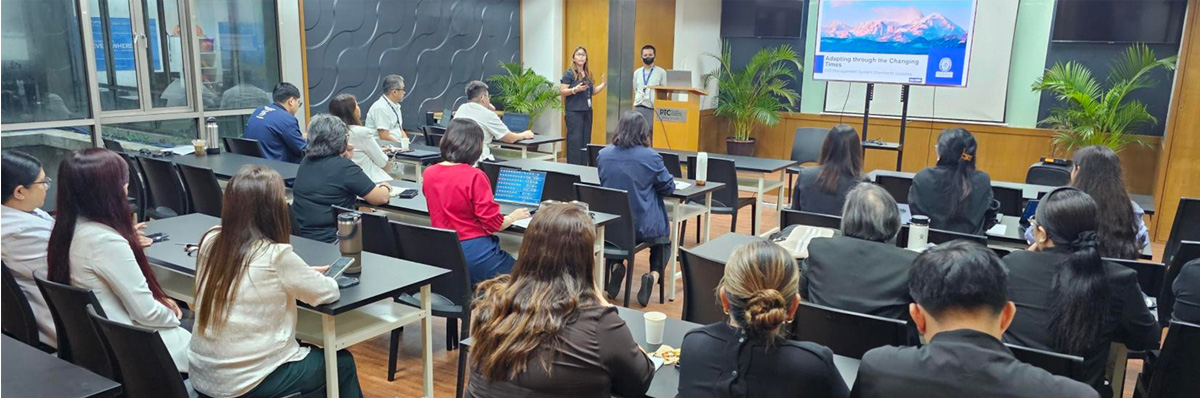
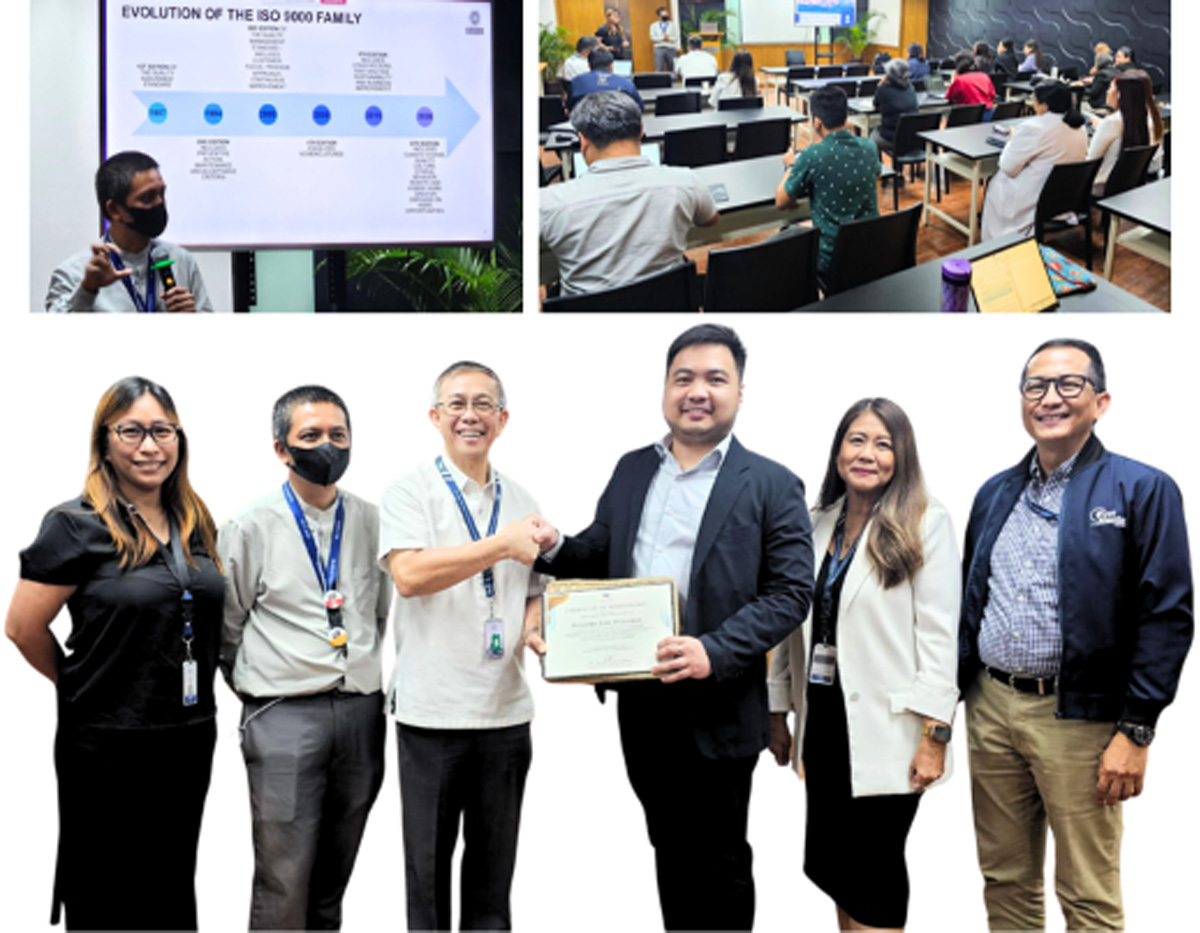
The Corporate Public Policy, Risk Management, and Sustainability (CPPRS)-SSRB Team in collaboration with Bureau Veritas held on 14 October 2026 an overview session on ISO 9001:2026 and ISO 14001:2026 for all Quality Management System (QMS) Leads.
The said activity set the context for the eventual transition to the 2026 standards for business units that are currently or are planning to secure 9001 (Quality Management System) and 14001 (Environmental Management System) certifications.
Mr. Noemel Jefferson Macunat (IMS Auditor and Verifier of Bureau Veritas) outlined the key differences between the 2015 and 2026 standards.
ISO 9001:2026 was officially published in September 2026. A 36-month transition period is set with ISO 9001:2015 certificates losing validity on 30 September 2029. Some of the major changes under ISO 9001:2026 are the following:
- Organizations are explicitly required to determine whether climate change is a relevant issue for their QMS and address climate-related requirements from interested parties
- Top management now has an explicit responsibility to promote a strong quality culture and ethical behavior
- Employee awareness is expanded to include the areas of quality culture and ethical behavior
- Risks and opportunities are more clearly segregated into distinct requirements rather than lumped together
ISO 14001:2026 was officially published in April 2026. A 36-month transition period is also set, with ISO 14001:2015 certificates losing validity on 30 April 2029. The following are expected under ISO 14001:2026:
- Stronger emphasis on climate-related risks and opportunities, integrated into the “context of the organization” (COTO)
- Clearer requirements, including explicit consideration of emergency situations with environmental impacts
- Greater emphasis on considering environmental aspects across the entire lifecycle, from sourcing to end-of-life
- A new clause on managing organizational changes that may impact the EMS
- Expanded focus on externally provided processes, products, and services (supply chain)
- More structured requirements for inputs and outputs, with emphasis on evaluating environmental performance

Comments are closed